Faith and Learning: Companions in the Same Cause
In spite of our variety of methods for coping with our very real hunger and thirst for truth, wisdom, and lasting happiness, we all continue to puzzle over the purpose of life. Human beings need to explore life and our surroundings. Even when survival needs are met, many of us continue to explore our existence out of curiosity. As we gather pearls of wisdom, we discover that the most satisfying truths are simply beautiful and beautifully simple.
As we mature and become more observant, many of us grow increasingly amazed by the energetic vitality and organized complexity of life and all of nature around us. In the spirit of exploration, human beings seek truth and meaning diligently, chasing down many paths of knowledge and avenues of life experience.
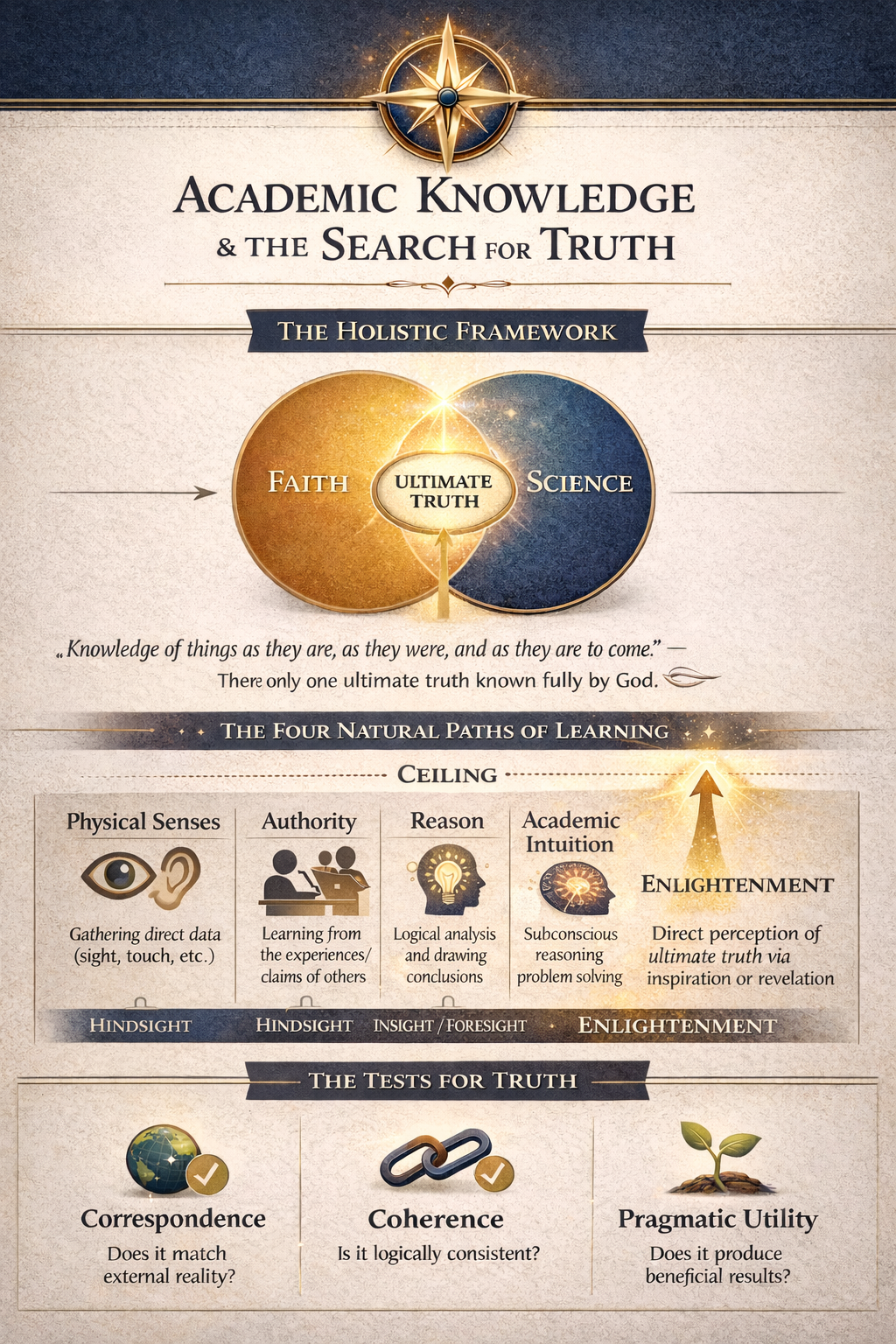
Latter-day Saints believe in eternal progression. Therefore, we place a high value on learning. We do distinguish between academic knowledge and spiritual knowledge, but believe these should be viewed as companions in the same cause. God and science are not mutually exclusive. If any conflict exists between academic knowledge and spiritual knowledge, it is the result of a lack of sufficient information within one or both domains of knowledge. Albert Einstein famously observed that science without religion is lame, and religion without science is blind (Albert Einstein, The World as I See It, 24–28). This chapter focuses on our views of academic knowledge, while our views of spirituality will be explored in the following chapter.
Please be patient in digesting the material for these two chapters. We have found high value in both types of knowledge, and have benefited from viewing them as two halves of a whole–what might be called a holistic epistemology. We believe all paths to knowledge are interconnected, each contributing something essential that the others cannot fully provide, together forming a more complete framework for understanding truth and our place within it.
The Nature of Truth: Faith Perspective
Many suspect that ultimate truth exists, but some question whether human beings are capable of "knowing" truth with any degree of certainty. Human beings have discovered so much about our existence in the universe, but what portion of reality yet escapes our attention? Of those quiet things yet hidden, both still and active, how much is there yet to learn? Regardless of our indefinable level of ignorance, what does it mean to have knowledge? What does it mean to know?
In preparation for our careers in education and throughout our combined decades in front of classrooms, my brother and I carefully considered these questions. Our formal studies and personal experiences reveal a disappointing lack of a unified definition of the word knowledge. In the place of clarity, numerous theories exist to explain the concept of knowledge. Though the definition of knowledge may be unclear, we feel it is important to plainly define the Latter-day Saint view of truth. One formal doctrine states: "Truth is knowledge of things as they are, and as they were, and as they are to come" (D&C 93:24). To this definition we add the following: The whole, ultimate truth is known only to God. There is only one ultimate truth; no separate truths exist for academics and spirituality. We can perceive or discover part of the whole truth, but we cannot know by academic means how correct this partial knowledge is in the ultimate sense. Truth does not have to be perceived, understood, believed, or justified to still be true.
How Human Beings Gain Knowledge
So, how do human beings gain knowledge of truth? In the biological sense, our brains have no way to directly experience the universe that exists outside of our skulls. In general, learning theories indicate that our journey to knowledge begins when we become aware of objects or events around us. Most sensory information that is funneled into our brains by the nervous system is ignored, but when we choose to pay attention to our senses, we begin to mentally sort and prioritize our perceptions. Using our imagination, we very quickly form mental images—basic ideas—of objects or events in our environment. Some have argued over whether humans can accurately imagine or reliably interpret external reality.
Still, with amazing speed our minds collect, compare, contrast, and evaluate ideas. If we come to accept an idea as true, it becomes a belief. Our minds consciously and subconsciously combine related ideas and beliefs into increasingly complicated concepts. Over time and with reflection, we combine numerous related concepts into themes of knowledge. Eventually, each individual develops an overarching worldview, which is one's basic cognitive orientation or mindset. One's evolving worldview is strongly influenced by the society and culture in which he or she lives. Unfortunately, one's worldview tends to become more rigid with age.
The Boundary Between Belief and Knowledge
Returning to the questions asked earlier, at what point can a collection of ideas and beliefs be called knowledge? How do we know if our knowledge is true? Through the ages, philosophers and scientists have repeatedly attempted to define the boundary between belief and knowledge, but debate continues even today.
There are two general ways that the word knowledge is used. First, in academic arenas an idea must be justified by overwhelming and reliable evidence to be believed, and the nature of the evidence determines the degree of certainty that the belief is true. Many academics hold that if a belief is actually known, then it cannot be false—effectively equating knowledge and truth. But is it possible for an idea to be supported by overwhelming evidence, be universally accepted by all humans to be true, be of enormous practical use, and still manage to be false?
The second general way the word knowledge is used is in the common conversational sense. In everyday usage, the word knowledge means familiarity with ideas, skills, or people. Perhaps the common language usage of the word knowledge reflects a greater degree of common sense than philosophy or science in that no requirement is made that one believe a body of ideas in order to have knowledge of them. Conversely, academic ideas must meet a high degree of certainty to be called knowledge.
Questions That Motivate Our Search
What does any of this have to do with Latter-day Saint Christianity? We challenge you to honestly answer the following questions for yourself: How can we have confidence that God truly exists? How can we have confidence that Jesus Christ was truly more than a man—that He was the very Son of God, even the divine Christ? How can we have confidence that our personal existence continues after death?
These questions motivate our writings. Indeed, these questions have motivated our living search for truth, meaning, and lasting happiness. We continue to keenly feel the driving need to explore both academic and spiritual knowledge. Our hope is that wisdom and peace will be the return on our investment.
The Four Paths to Knowledge
Putting aside arguments over definitions, the search for knowledge of truth must be confronted directly, carefully, and honestly. Most importantly, we must gain wisdom in the process—true wisdom being the correct application of knowledge. There are four general ways we learn. These are called paths to knowledge: Physical Senses—We can gather direct knowledge from our own powers of sight, smell, taste, hearing, and touch. Authority—We can gather indirect knowledge from others who claim to possess it with some degree of certainty. Reason—We can gather knowledge from the mental processes involved in the logical consideration of potential truths and the identification of false conclusions. Intuition—We can gather knowledge without any apparent use of the senses or application of reason.
Learning from Experience and Authority
As paths to knowledge, physical senses and authority involve learning after gathering real-world experiences. Through our physical senses we can gain firsthand, practical knowledge by experiencing the consequences of our own personal choices. This can be dangerous, but it is effective. As a more careful approach, by listening to the teachings of authority figures we can gain secondhand, practical knowledge. This is learning from the experiences of others. By the paths of both physical senses and authority, knowledge and wisdom can be gained from hindsight.
Reason and Its Methods
As alternative paths to knowledge, reason and intuition involve learning without having had personal experiences. These are the most cautious approaches to learning. Reason is the conscious use of logic to formulate theoretical knowledge. Reasoning involves analysis of all information available, careful consideration of foreseeable consequences of our choices, and drawing creative conclusions.
Intuition: Academic and Spiritual
Intuition is a more mysterious path to knowledge, which manifests itself in at least two varieties. The first is academic intuition, sometimes called rational intuition. Academic intuition involves subconscious reasoning processes to draw conclusions in novel situations. Examples of such subconscious processes include recognition of sensory information, imaginative problem solving, and memories of emotions and past experience. This all happens without our conscious minds recognizing the source of such theoretical knowledge. Such intuited conclusions just seem to come to us mysteriously, yet this is a rational process.
The second type of intuition is spiritual intuition, sometimes called irrational intuition. No insult is implied here—irrational simply means that human reasoning is not the source of such knowledge. Spiritual intuition involves the direct perception of truth by inspiration or revelation, even to the extent of gaining knowledge of events or foreknowledge of the consequences of our choices that could not come by any other means. Revelation (received consciously) and inspiration (perceived subconsciously) both result in spiritual knowledge. We use the term spiritual to describe this type of intuition in spite of disagreements over the existence of the human spirit. In general, the mechanisms by which knowledge is revealed or perceived by one who spiritually intuits truth are poorly understood. This type of intuition will be explored more fully in the following chapter.
Hindsight, Insight, and Foresight
In the cases of both reasoning and intuition, knowledge and wisdom can be gained from insight, sometimes also called foresight when relating to the future. Academic foresight results in predictions based on logic, whereas spiritual foresight results in prophecies based on revelation or inspiration.
Testing Our Beliefs for Truth
The next important question we should ask is this: What do we do with knowledge when we get it? When we come to have confidence that an idea is true, we must incorporate the new belief into our existing frameworks of knowledge. This can be exhilarating, but it can also be uncomfortable. If a belief will not easily fit existing frameworks of knowledge, we are forced to adjust our collection of knowledge to incorporate the novel idea. Depending on the implications of the new ideas, such adjustments could be minor, or they might be so massive as to alter our entire worldview.
Being open to new ideas is seen as positive, but this requires both honesty and courage. If new ideas are too disruptive or too painful to accept, some reject them in favor of maintaining existing frameworks of knowledge. This can be a fear response. Some do not fearfully reject disruptive ideas outright, but instead adopt a noncommittal "wait and see" approach. Neither of these responses means that the new ideas are false, just that they were too overwhelming for an individual or group to handle at the moment.
Three Tests for Truth
Through the ages, philosophers have developed criteria by which beliefs can be tested. Three primary tests form a system of checks and balances for the mind.
Correspondence asks whether an idea matches external reality. A true idea must accurately describe things as they actually are. If I believe it is raining outside, I can look through the window and verify whether my belief corresponds to the observable facts.
Coherence asks whether an idea remains consistent across all situations. A true idea must be precisely true—not true in one circumstance and false in another. If objects fall toward the center of the Earth in my backyard, they must also fall toward the center in my neighbor's yard.
Pragmatic utility asks whether an idea produces reliable, beneficial results when applied. A true idea should work when put into practice. If a mathematical formula consistently predicts natural phenomena, its utility provides evidence of its truth.
These tests are valuable, but the honest inquirer must practice epistemic humility. Even our most rigorously tested knowledge reaches only the level of "beyond reasonable doubt." Human faculties, however refined, cannot guarantee absolute certainty. Humble scholars are always mindful of the very high probability of human error. Human pursuits that depend upon interpretation of evidence and the application of reason—whether in law or academics—often result in phrases like "the preponderance of evidence," "beyond a reasonable doubt," "truth value," and "degree of certainty."
The Contributions of Human Learning
The many topics explored in our writings deal with the value and relevance of both academic and spiritual approaches to hindsight, insight, and foresight in the pursuit of truth, wisdom, and lasting happiness. Both approaches are of great value, yet each is more or less appropriate for differing circumstances. So how do we develop our talents for hindsight, insight, and foresight?
Over numberless generations, human beings have cultivated sophisticated academic approaches to gaining and sharing knowledge. Discovering interesting and useful patterns in the human experience can be approached academically with philosophies, arts, and sciences. These generate an enormous variety of viewpoints, wonderful questions, and precious information.
Philosophy enlivens the mind with exercises in questioning our existence and identifying alternative approaches to truth. The arts help us to better communicate, to experience the world from different viewpoints, and to more deeply consider both nature and the human condition. Social sciences help us to remember past lessons and to deal with the wide range of current human behaviors. Natural sciences help us to observe our surroundings, perceive patterns, and rapidly develop technologies that can dramatically expand the human experience. Formal sciences such as mathematics give us the ability to accurately measure, analyze, interpret, and predict natural patterns of all varieties with some degree of consistency.
Please do not get the false impression that we place little value on human academics. My brother and I have devoted much time and effort to acquaint ourselves with the learning of humankind. We have received a small collection of degrees and honors from universities. We have gained a sincere appreciation for the advancement of the human mind. The contributions of philosophies, arts, and sciences to the human experience are incalculable. Yet, we are sufficiently acquainted with these to grasp how much human beings have yet to learn and experience. We are painfully aware that there are numerous individuals of greater learning, but we are sufficiently educated to discern frustrating limitations to academic approaches to truth. In addition, we have both often heard the humble admission from within the ranks of the highly educated that the more humans learn, the stronger is the realization that we know very little.
The Limitations of Academic Knowledge
Philosophy! Arts! Sciences! For ages, these have been intellectual altars before which many have chosen to worship human ingenuity. Yet an embarrassing truth is recognized by humble and honest intellectuals: in spite of all our discoveries and greatness, human academics cannot produce or define ultimate truth and meaning with finality. Strangely, humans often react to this embarrassing limitation by trying in vain to define truth by means of democracy or even tyranny. Public sentiment and political actions cannot produce truth. Left to our own devices, we can only slowly and imperfectly approach genuine truth by academic means.
Mature scholars admit that academic knowledge is often based on sweeping, foundational assumptions. What if these academic assumptions are even a little wrong? In spite of our valuable accomplishments in analyzing the human condition and our noble construction of technology, human academics cannot produce ultimate truth. Instead, we often remain trapped in expansive and energetic debate, following an endless pattern of ever learning but never coming to a sure knowledge of truth (2 Timothy 3:7).
Anyone familiar with the history of science remembers well the lessons of discarded theories and models such as spontaneous generation, classical elements, flat earth, geocentric universe, and static universe. We like to think that we are far more advanced than the "primitive thinkers" who produced such ideas, when the fact is that ancient scholars were at least as brilliant as we are. Like us, they formed their philosophies and theories using the best evidence and tools available at the time. We also like to think that we have vastly superior evidence as well as more perfect tools of science with which to discern truth. It is humbling to consider what scholars of future generations will think of the imperfect theories and primitive tools of our day. Will we ever learn the lessons of simple humility?
The Assumption of an Intelligent Creator
Surveys indicate that most of us believe or suspect that there is intelligence behind the formation of our universe and the precious life it contains. Common experience dictates that every organized structure or system has an architect. An appealing belief is that complex organization is the footprint of intelligence. Many innately suspect that such order and majesty as are found in nature cannot be without cause or effect. The hopeful insist that there must be purpose to life and that our surroundings are a work of art, the result of devoted attention. There are many religions, each with their own doctrines and practices. The simple assumption is made that all of life and existence has come from a source and is moving toward some destiny.
Some view this hopeful assumption as an ignorant and uneducated mindset. "Advanced thought" sometimes leads the mind to question whether there is anything more to our existence than identifiable patterns of physical laws—an empirically identifiable evolution of the organization of matter, energy, and dimension. Paul spoke of this when he wrote: "The natural man receiveth not the things of the Spirit of God: for they are foolishness unto him: neither can he know them, because they are spiritually discerned" (1 Corinthians 2:14). The possibility of genuine spiritual intuition is often rejected. Empiricism is simply an intellectually disguised statement of old: "I will only believe what I can see." Clinging only to humanistic knowledge restricts us to merely observing and manipulating our existence rather than seeking to identify its purpose. At best, this choice is a sore limitation on the human experience.
The Ceiling of the Natural Framework
Think deeply on this world and the universe in which it moves. Change seems to be the only constant of our existence. The challenges and experiences that shape our lives are a kaleidoscope, continuously altering, fresh and new each day. Yet behind this backdrop of change there are simple truths that remain ever constant. Though we often search for truth collectively, the recognition, confirmation, and acceptance of these truths are an intensely personal, even spiritual, experience.
But how are we to begin searching, and what questions ought we to ask? We believe that the following are some of the most rewarding questions: How did all this change begin? Is there a higher intelligence guiding all this change? What are the origin and future of my changing personal existence? Is there a purpose to all this change? Is there help for me as my existence changes?
A more personal question that we must all confront is this: Am I ready, willing, and able to handle the answers to any of these questions? When honestly considering this last question, remember this insightful triplet of proverbs: great ignorance leads to great fear; great knowledge leads to great sorrow; great wisdom leads to great peace.
Questions That Exceed the Framework
This natural framework—the four faculties of senses, authority, reason, and academic intuition—is not defective. It functions precisely as designed for the questions it is equipped to address. Philosophy, arts, and sciences have yielded incalculable benefits to the human experience. Yet certain existential questions exceed its reach: Why is there something rather than nothing? Does a loving God truly exist? Does personal consciousness persist beyond death? What is the ultimate purpose of my existence?
Science can describe how things work, but it cannot explain why we exist. These are not failures of the natural framework—the framework itself predicts these limits. If ultimate truth is "knowledge of things as they are, and as they were, and as they are to come" (D&C 93:24), and our natural faculties perceive only a fraction of that whole, we should expect to reach a ceiling.
Here, the seeker faces a choice: accept permanent ignorance on life's most vital questions, or consider whether there exists a faculty beyond the natural ones.
Our Witness
We, the writers, have come to know with certainty that there is more to humankind than our intellect and flesh. The reality of the human spirit and spiritual intuition may seem foolish to the educated mind. Often, those of great learning view the faithful as blind and deaf to the satisfaction of logic and reasoning. However, to those who have experienced the reality of the human spirit, men and women of exclusively empirical mindset seem blind and deaf to many of the most beautiful and moving experiences of life.
We have come to believe that it is good to seek knowledge, better to seek wisdom, and best to seek enlightenment. It is our experience that, whether through the practice of organized religion or through individual effort, the discerning of ultimate truth depends entirely upon spiritual intuition. During our lives we have learned a measure of spiritual sensitivity sufficient to have discovered some basic and important truths. Please give honest consideration to our writings.
Though we are still challenged by the worries, disappointments, and imperfections of mortal life, we have found profound underlying peace, hope, and joy in the application of the knowledge we wish to share. We have seen the happy effects of hope and faith in the lives of many others. We offer you the following personal witnesses in words of plainness: Ultimate truth can be known, at least in part—a significant and meaningful part. An individual, immortal spirit dwells within the flesh of each person. God lives and wishes to help us. Life has grand purpose and great meaning.
We caution you: do not be persuaded by our words alone! Though there are beautiful and hopeful ideas in this book, their truth can only be known by the power of God and verified through your own personal spiritual experiences (Matthew 16:17; Moroni 10:3–5). It is our simple hope that our efforts will engender in your heart a desire to search for God—though He has never been far from you—as well as a desire to search for truth, meaning, and lasting happiness (Acts 17:27; D&C 88:63). We invite you to experiment on our words (Alma 32:27).
If the natural faculties have brought you to the ceiling of what they can provide, the following chapter will explore the fifth faculty—the one that completes the others. We testify that God has not left His children without a way to know Him and the truths He has in store for us. This we witness in the name of Jesus Christ. Amen.